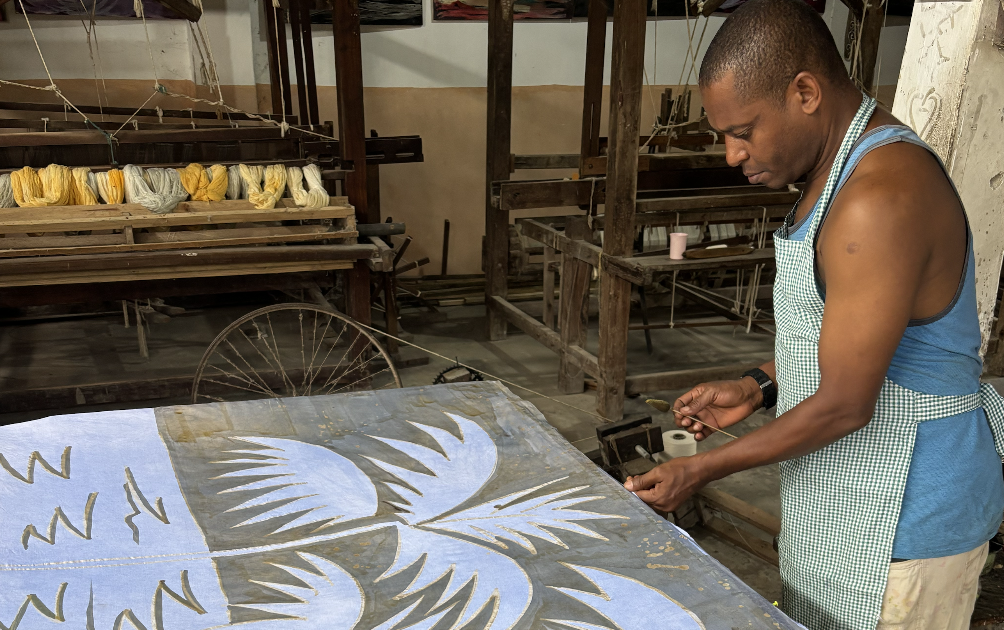
When I arrive a couple of days later, Mussa greets me in Swahili and gives me a big friendly handshake. He’s wearing an apron, well-worn workshop pants and greyish Crocs. He later tells me that his eldest daughter bought his Crocs at the market, decided she didn’t like them and was ready to throw them away when he saved them. I tell him that people in Australia either love them or hate them and he smiles like he doesn’t care what anyone thinks of his rescued placky clogs.
Mussa is a Bantu man, born and bred in Zanzibar. He speaks Swahili, English and can get by in Arabic too. He has four children and tells me he wanted ten: ‘enough to run a business or field a football team’, he says with a big smile. He inherited the artist’s life from his grandfather and, as tradition dictates, will pass it on to a willing grandchild.
We begin with a tour of his magnificent workshop – a collection of showrooms jammed with art as well as workshop spaces for weaving, painting, batik, pottery, woodwork and a sewing room. A woman is sewing at one of the machines and as we walk through Mussa says, ‘She’s a widow…’ Later I look up why this is significant in Islamic life and I read that ‘taking care of a widow is considered a highly meritorious act.’ But there is nothing religiously meritorious about Mussa. He just loves his community and it shines in every room of his life’s work.
The next room is a classroom. Zanzibar does not have a College of Fine Arts nor a visual arts curriculum in schools. Mussa thinks this is a tragedy so he teaches local educators how to teach art, for free, so they can sneak it into their classrooms. The white board has a cube drawn on it – the standard perspective cube all art students have seen when learning to draw.
The next room after that is for the local street boys who have nothing to do in the evenings so they come at sunset to learn some English. There’s a huge map of Africa on the wall and he points to it and says ‘We talk about opportunities to work and travel.’ Then he tells me of his ambitious plans for an artists’ residency program and a local playground but that he needs 15 million shillings to complete the dream.
Mussa’s workshop took off around the turn of the century when he met an Aussie. Garry from Gosford saw Mussa’s art in Stone Town: beautiful large scale screen prints and batik works of seascapes and stone architecture, the famous ornate doors of Zanzibar and traditional Swahili life. Garry recognised a talented artist and took a collection back to Australia and sold them on Mussa’s behalf. The funds set up the workshop and the two men remained friends until Garry died in 2005.
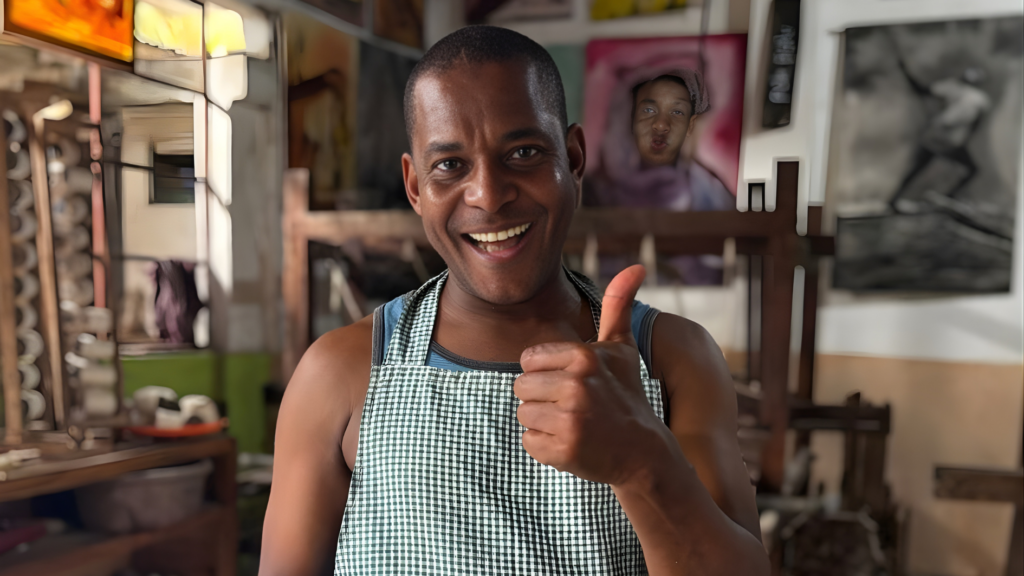
Mussa’s style is nothing like the art I’ve seen in the laneways of Stone Town. He uses a gentle colour palette which is far more alluring than the primary colours and splatter work of tourist painters who churn out lions and elephants (which do not exist in Zanzibar). I spy one of Mussa’s paintings that I want to buy, but later I can’t find it again in the labyrinth of gallery walls in his workshop.
‘Time to make art,’ says Mussa. We take a large sheet of white cotton fabric (made in Tanzania) and pin it across a timber frame. Then I pencil in my design and we go over that together with hot wax using brushes Mussa makes from old mattress foam. Then we move to the dye room and he makes me put on thick industrial rubber gloves he’s just rinsed inside and out under the tap. They feel gross on my hands and I tell him it feels like pregnancy testing cows and he laughs his head off.
Together we mix the fine, powdered dyes and add caustic soda, sodium hydrosulphite and boiling water. Then we dunk the waxed-up fabric in and crush it for a crackle effect in the final work. We do this whole process with wax and dye three times with new colours to build on the final piece.
After three hours of batik and chai and talking while each layer dries in the sun, Mussa says he wants to show me something and we set off in my dusty little two-door hire car. After a few bends in the road he says, ‘There is only one small river to cross…’ We get through the river and he firmly declares, ‘Lucy, you are not a coward.’
The thing he wants to show me is a house he has built for street boys and the widow who sews, with a big fenced playground under a citrus tree, heaving with fruit. The playground, he tells me, is for story time after school where elders will tell traditional stories to preserve their culture. He funds all this from his workshop but this is one of the projects which needs millions of shillings to complete. It all looks about 70% finished. I love the idea of the artist’s residence which also needs funds and Lucy McFundraiser starts to think.
My heart is so full from a huge day of textile joy and Tanzanian local life with Mussa the King of Batik and his wild enthusiasm for his community. I drive back to Stone Town with my first ever completed batik masterpiece, through the pot holes of Bububu bound for air-conditioned comfort and a solid session to background check Mussa’s story. He comes up as legit as a Bunnings receipt.
I hereby give you a GoFundMe campaign, established for Mussa’s vision for artists’ residencies and completed house and playground in Zanzibar. Please give what you can.
CLICK HERE TO MAKE A DONATION 👈🏼 👈🏼 👈🏼 👈🏼