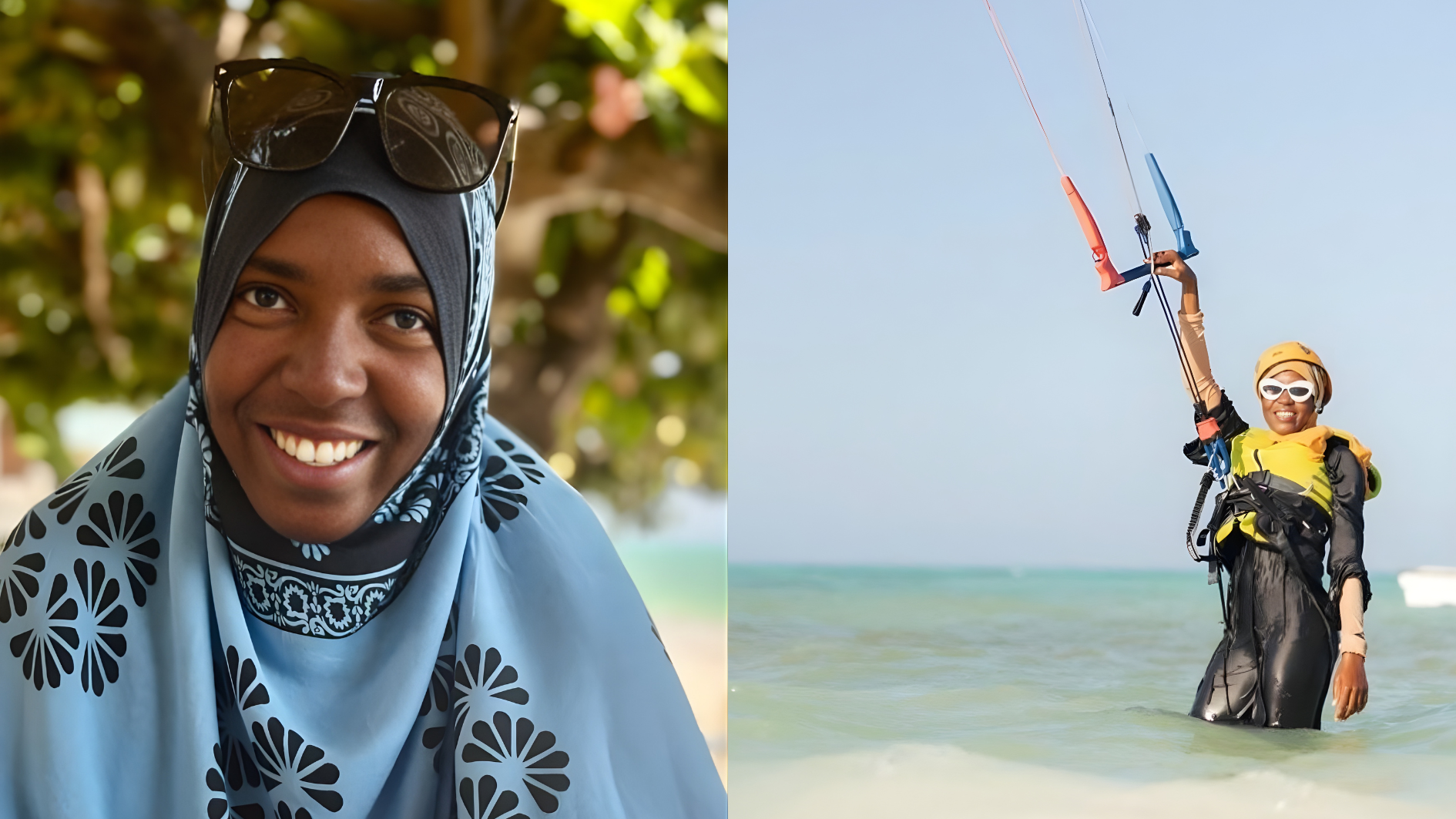
I didn’t know that the next week of my African adventure was in the capital of kite surfing, but there I was. Scattered up the beach were hundreds of kites in the air and the stretch of sand further along was packed for a competition. A couple of days into my stay, I stood in the thick of the beach crowd watching the competition and noticed several women killing it in a sport that looked physically and technically very difficult. I wanted to meet one of them so I went to my faithful organiser of all things, WhatsApp, and that’s how I met Thamrat, who is set to become a qualified kite surfing instructor, and the first woman to do so in all of Tanzania.
We meet for a coffee under the shade of a huge Indian Almond tree at Paje and as soon as she arrives, Thamrat orders a chai ‘so that she might stay’. I don’t know what this really means until later I learn that the resorts and cafes along Paje’s golden mile usually don’t allow locals. You could set the next series of The White Lotus in this place, I tell ya. Our waiter looks like JayZ if JayZ couldn’t afford veneers. He chats to Thamrat briefly before a chai arrives and then we talk.
Thamrat was born in Paje, the twelfth child of 14, of the Shirazi people of Zanzibar. Her parents have both passed away; all but three of her siblings went on to tertiary education. Thamrat’s English is perfect and she has a degree in library management. I squeal, ‘Librarians are the best!’ and she smiles and then her face drops. ‘But I could not find employment, so I returned to Paje to help with a seafood business here. Women collect seaweed, shellfish and octopus, and can make a good living that way.’ I have seen women out on the reef when the tide is out, doing just that, all over this island from Nungwi to Fumba.
Thamrat (which sounds like a great skater name to me) landed on kite surfing when a school friend was working for a kite school that was losing business every time Arab women wanted to learn. They would ask for a female instructor, but there weren’t any in the whole of Tanzania. Not one.
‘I said, I will only consider this if I can dress as a Muslim woman should,’ she tells me. So she figured out a full length cozzie and water veil, then off she went to work for a kite surfing school.
Several months later, Thamrat met a French woman named Leilani Brunel (Paje seems to attract a lot of Frenchies) who, with a philanthropic friend, noticed that most kite surfing schools in Paje were foreign-owned by men. In response, they created Rise with the Wind, a 12-month program training local women to become internationally certified kite surfing instructors. Thamrat, aged 30, and her sister, aged 28, are in the first intake of six women – three from Paje and three from mainland Tanzania – who aim to reach the level required for certification by the International Kiteboarding Organization (IKO) by mid-2026.
I ask Thamrat if she has plans to create her own kite school in her home stretch of sand and she leans in. ‘I have seen a gap in the market,’ she tells me with a knowing raise of her eyebrows. ‘Kite surfers have to order spare parts online and wait two weeks for them to arrive. Then their kite is out of action for weeks. Kite schools lose business while their kites wait for repair. I am going to set up a shop here in Zanzibar. I will have their kites out within 24 hours.’ All she needs is a capital injection of USD$5000 to buy the stock and rent a space.
Thamrat and her classmates train at Paje and a less crowded stretch of reef at Jambiani. I drive down to Jambiani and watch two kite surfers from the clifftop, carving up the water and riding the wind so fast it must make every cell in their body ache. Thamrat competed in the days when I was watching from Paje and she tells me she finished third from last. ‘But at least I finished. Others went faster than me and didn’t complete the race.’ She competed in the racing category, not Big Air, the spectacular jump tricks I’d seen on my first day on the beach.
Later in our conversation under the almond tree, Thamrat mentions pushback from some members of her local community for working in kite surfing. ‘A local fisherman told me I should be married, have children and keep a home like a good Zanzibari woman. He offered to take me as his second wife.’ I spit up my coffee and she tips her head to acknowledge the audacity of the fisherman and says, ‘He tries to joke but I am an independent woman. Not married, no children.’ I wonder if Fisher Man could stick a fish in his mouth and invest in her business instead.
I admire her so much I want to nominate Thamrat for Tanzanian of the Year. This is a woman who has learned how to ride the wind, then decided on her own terms where it would take her. Salute, Thamrat of Paje.
Follow Rise with the Wind on Instagram.